top of page
  • Writer: Ziggurat Realestatecorp
    Ziggurat Realestatecorp
  • Nov 3
  • 4 min read

Upgrades provide natural conversations, cameras that find lost dogs


A decade ago, Amazon’s Echo and Google’s Home offered us a taste of the future: We speak, and our homes respond. But when ChatGPT and other AI chatbots arrived, those “smart” speakers started to feel pretty basic.


Google is rolling out Gemini generative-AI smarts to existing devices at the end of the month.

Now that they’re getting a generative- AI overhaul, the question is: Can we get more out of devices that until now have been great at setting kitchen timers, reading the weather and playing music?


Most homes are “smart”: Consumer- tech tracking firm Parks Associates reports just over half of internet-connected U.S. households own at least one smart speaker. Yet smart-home adoption has stalled since peaking in 2021, says research firm IDC. Anyone who has wrestled with a smart light, thermostat or other home tech knows the pain. A multitude of fussy apps and the need to memorize countless verbal commands were a big part of the problem.


Amazon’s Alexa+ and Google’s Gemini aim to fix that, by making smart homes less dumb. The tech giants introduced new speakers, home displays and cameras this week to capitalize on their evolved assistants, but most existing devices are also compatible.


Gemini for Home arrives at the end of the month, and Amazon says 10 million households have early access to Alexa+. As we wait for Apple’s Siri to catch up, here are the three big changes coming to our homes right now.


Cameras that tell you what’s happening


When you get a security camera alert, you tend to open an app and peer in wondering at what might be lurking in or outside your house.


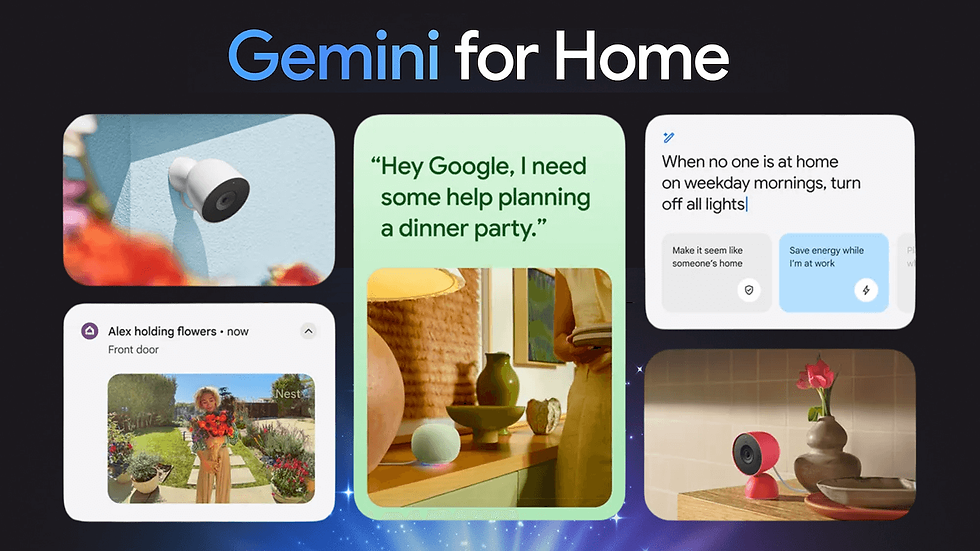
With Gemini for Home—which you can gain early access now in the Google Home app—Nest cam notifications have more useful descriptions, such as “Dog jumped out of playpen,” or “USPS dropped a package off on your porch.”

ree

Inside the app, you can ask queries like, “When did the gardener arrive last week?” to pull up relevant clips. In a demo, “What ate my grass?” showed rabbits munching in the garden. The cameras can also summarize daily highlights such as kid activity or package delivery. Amazon’s Ring announced similar features called Video Descriptions and Smart Video Search earlier this year— available to Home Premium plans.


In December, Ring will add Familiar Faces, allowing its doorbells and other cameras to recognize people you know. The system matches faces based on your videos only, and the identification is stored with your account. Also coming in December is a service that allows Alexa+ to greet people at the door, whether they’re familiar or unfamiliar faces. Ring is attempting a more ambitious task as well: finding lost dogs.


ree

You can trigger a “Search Party” by providing details and a photo of your missing dog. Any outdoor Ring cameras in the vicinity that spot your dog will alert those camera owners.


If they want to notify you, they can with a tap. (They can also choose to ignore the alert, and even disable Search Party entirely.) Search Party, available in November, is only for dogs at launch, but Amazon is looking beyond canines. In addition to evaluating algorithms for other pets—hello, cats!—it is considering monitoring for lost people as well.


“There are thousands of people missing with dementia all the time, so you can imagine looking for them,” says Jamie Siminoff, who founded Ring and currently heads the Amazon subsidiary.


Siminoff noted the privacy concerns, and emphasized that videos will never be shared without the consent of the camera users. In addition, Ring says it doesn’t use private customer videos to train its AI models.


Speakers that have real conversations


As soon as you upgrade to Alexa+ or Gemini for Home, the biggest change you’ll notice is the humanness of the assistant. Conversations flow freely; you don’t need to repeat the wake word. We’ve asked Alexa+ about classical architecture, amenities at a campground, whether selenium is water-soluble and more, with informative responses.


We have yet to stump it. Responses to conventional smart-speaker requests are improving, too. When Gemini for Home rolls out, you can say, “Set a timer for roasted carrots”—Gemini will ask appropriate follow-ups and start a countdown. You can also ask: “Play a recent podcast featuring Serena Williams” or “My dishwasher isn’t draining.


What should I check first?” Like ChatGPT, these AI-powered assistants sometimes hallucinate, too. Alexa+ offered to make a restaurant reservation via Open- Table. The restaurant wasn’t even on the app yet it insisted we had a booking. Hey, that’s why it’s still early access.


Automation without the app headache


The magic of the smart home is when stuff happens exactly when you need it to. Previously, this felt like it required a computer-engineering degree. Now, you can create these automations just by describing what you want. Seriously.


For example, asking Gemini to “make me feel safer” will check that the doors are locked, windows closed and—if you’re not home— lights are toggling on and off. Amazon’s devices chief, Panos Panay, shared how his wife’s frustration with their son—“He just leaves the lights on!”—led her to ask Alexa to turn off lights each night at a given time. She didn’t realize she had created a routine, he says. Amazon’s new devices are equipped with more sensors to understand what’s happening in your home.


In other features rolling out in the coming months, they’ll learn habits—who’s home during the day, what doors should be locked after 10 p.m.—and will be able to adjust routines and alerts based on those patterns, the company says. (Alexa+ will come with all the new Echo devices.) We’ll be doing more testing with Alexa+, Gemini for Home and the new devices.


But these smart assistants already feel less like high-maintenance houseguests and more like family: They listen, learn and might even help find the missing dog. 


  • Writer: Ziggurat Realestatecorp
    Ziggurat Realestatecorp
  • Nov 2
  • 2 min read

House prices rose more than expected last month in a further sign of resilient demand despite the possibility of property-related tax reforms in the budget. Average prices rose 0.3 per cent in October after rising by 0.5 per cent in September, mortgage lender Nationwide’s latest house price index showed.


Year-on-year prices were 2.4 per cent higher, up from a 2.2 per cent annual increase in September.


ree

Economists had forecast no change over the month and a 2.3 per cent increase over the year.


Robert Gardner, Nationwide’s chief Martin Strydom economist, said: “Against a backdrop of subdued consumer confidence and signs of weakening in the labor market, this performance indicates resilience, especially since mortgage rates are more than double the level they were before Covid struck and house prices are close to all-time highs.


”The figures come after Bank of England data on Wednesday showed that the number of mortgages approved by lenders in September came in higher than expected. Mortgage approvals totalled65,944 during the month, the highest figure since December and above economists’ forecasts of 64,000.


The data are at odds with other measures of the housing market which have suggested a slowing in price growth in recent months, attributed to caution among homebuyers before the budget on November 26.


A report by the Royal Institution of Chartered Surveyors published in October quoted Timothy Shaw, of Vincent Shaw estate agents in Cambridge as saying that the housing market was in a “state of semi-paralysis”, with agencies reporting another fall in inquiries, sales, new instructions and prices in September.


It said the autumn slowdown, brought on by speculation about potential reforms to property taxes, has “become more firmly entrenched of late” .Rachel Reeves, the chancellor, has said that “higher taxes on the wealthy …will be part of the story” in the budget, with some form of property tax seen as a possibility.


Ashley Webb, UK economist at Capital Economics, said that data suggested that “homebuyers may not be as fazed by the threat of tax rises in the budget on November 26, potentially on property, as it first appeared”.


Elliott Jordan-Doak, a senior UK economist at Pantheon Macroeconomics, said that while house prices had remained subdued, they were likely to continue rising slowly over the coming months.“ Some homebuyers are taking await-and-see approach to the budget, which is weighing slightly on sentiment in the market.


“But the activity indicators holding up better than their survey-based signals suggests to us that demand remains robust,” he said. Nationwide said housing affordability was likely to improve modestly if income growth continues to outpace house price growth. It also expects borrowing costs to ease, bolstering buyer demand.


Goldman Sachs said this week that after a sharp deterioration in economic data, it expected the Bank of England to cut interest rates by a quarter point to3.75 per cent next week.


Source: The Times


  • Writer: Ziggurat Realestatecorp
    Ziggurat Realestatecorp
  • Nov 1
  • 3 min read

The Philippines’ pension system remained the third worst in the world, according to the 2025 edition of Mercer CFA Institute’s Global Pension Index.


The Philippines’ score, which is graded based on adequacy, sustainability, and integrity, improved to 47.1 in 2025 from 45.8 in 2024, primarily due to “clarification of regulations,” the report said.


ree

However, the score was way below the 64.5 global average, and the third-lowest score among 52 retirement income systems in the index. Last year, the Philippines’ pension system was also the third worst out of 48 systems.


In the report, the pension systems in the Philippines, Turkey, Argentina and India, were given a “D” grade. This means the pension system has some “desirable” features but also has “major weaknesses” that should be addressed.


“Without these improvements, its efficacy and sustainability are in doubt,” the report said.


The Netherlands had the best pension system with a score of 85.4. Aside from the Netherlands, the pension systems in Iceland, Denmark, Singapore and Israel were also given an “A” grade, which meant they had robust and sustainable systems that deliver good benefits with a high level of integrity.


The Global Pension Index reviews an economy’s retirement income systems based on three weighted subindices: adequacy, sustainability, and integrity.


The Philippines’ adequacy score went down to 40.6 in 2025 from 41.7 in 2024. This was below the global average of 66.1 for adequacy.


Its sustainability score improved to 64.4 from 63.4, which was higher than the global average of 55.3.


For integrity, the Philippines’ score inched up to 33.2 from 27.7. However, this was significantly lower than the global average score of 74.7.


The Philippines was the only economy in the integrity sub-index that had an “E” grade, which indicates “a poor system that may be in the early stages of development or nonexistent.”


“The Philippines’ retirement income system comprises a small basic pension and an earnings-related social security pension,” the report said.


“Members can receive a lifetime pension if they have contributed for a minimum of 180 months for government and 120 months for nongovernment members. Both schemes provide calibrated benefits if the minimum number of contributions is not satisfied.”


The Mercer CFA Institute report said the Philippine pension systems could be improved if the minimum level of support for the poorest elderly is increased and the benefits are aligned with the country’s cost of living.


It also said the Philippines’ requirements for vesting in private sector plans should be improved.


The report said the local pension system lacks non-cashout options for retirement plan proceeds, so they are preserved for retirement purposes.


It also cited the need to improve governance requirements for the private pension system.


In the Philippines, there are two main pension funds — the Social Security System (SSS) for private workers and the Government Service Insurance System  for government workers.


Starting Jan. 1 this year, the SSS increased the contribution rate to 15%, up from 14%. Under Republic Act No. 11199 or the Social Security Act of 2018, the SSS implemented incremental contribution rate hikes of one percentage point every two years starting in 2019 from the original contribution rate of 11%.


All SSS pensioners as of Aug. 31, 2025 began receiving higher pensions starting September this year. Retirement and disability pensions will increase by 10% annually every September until 2027, while death or survivor pensions will rise by 5% each year.


© Copyright 2018 by Ziggurat Real Estate Corp. All Rights Reserved.

  • Facebook Social Icon
  • Instagram
  • Twitter Social Icon
  • flipboard_mrsw
  • RSS
bottom of page