top of page

The Philippines fell to near bottom in an annual global ranking of countries’ ability to attract and retain a skilled workforce, amid a decline in the quality of life, the Institute for Management Development (IMD) World Competitiveness Center said.


In the IMD’s World Talent Ranking (WTR) 2025, the Philippines slipped a spot to 64th out of 69 countries. Last year, it ranked 63rd out of 67 economies.


This was the Philippines’ worst showing in 20 years or since 2005.


ree

The Philippines’ talent competitiveness also continued to lag behind Asia-Pacific neighbors. It ranked 13th out of 14 Asia-Pacific countries, better only than Mongolia (69th overall).


Hong Kong (4th) was the highest-ranking economy in the Asia-Pacific. It was followed by Singapore (7th), Taiwan (17th), Australia (19th), Malaysia (25th), New Zealand (33rd), South Korea (37th), China (38th), Japan (40th), Thailand (43rd), Indonesia (53rd), and India (63rd).

The global talent index was again dominated by European economies led by Switzerland (1st overall), Luxembourg (2nd), and Iceland (3rd).


The WTR rankings are based on three factors: “appeal,” or the ability of the economy to attract foreign talent and retain local talent; “investment and development,” which refers to the measurement of resources allotted to develop a homegrown workforce; and “readiness,” or the quality of the skills in a country’s talent pool.


The Philippines saw a decline in all factors, dropping two places to 66th in investment and development. It slipped two spots to 56th in appeal and fell six places to 58th in readiness.


“Generally speaking, the Philippines is a net exporter of talent. And it means that it will always find it difficult to retain the homegrown talent in the country,” Arturo Bris, director of the World Competitiveness Center and professor of finance at IMD, said at a hybrid press briefing.


“At the same time, interestingly, if you look at our indicators, the Philippines ranks 13th in the availability of skilled labor in the country. So, it seems that executives and leaders in the country do not feel that they don’t find the talent that they would need,” he added.


LOW QUALITY OF LIFE


Mr. Bris noted the country has steadily declined in the rankings over the last few years and lagged in competitiveness mainly due to low quality of life in the Philippines versus its regional peers.


“I think the main driver is a declining quality of life. And again, remember that quality of life encompasses many different factors,” Mr. Bris said.


“The quality of life in the country, especially compared to other neighbors, like Thailand, Singapore, or Indonesia, is lower,” he added.


In particular, he said that the quality of life in the Philippines ranked 60th out of 69 economies. It ranked 49th in exposure to pollution, and 31st in management remuneration.


Philippine Institute for Development Studies Senior Research Fellow John Paolo R. Rivera said that the country’s low ranking in the talent index “reflects chronic underinvestment in education, weak training systems, and poor talent retention.”


“Compared with Asia-Pacific peers like Malaysia or Singapore, we lag behind in both talent readiness and quality of life. To catch up, we must improve public spending on education, build industry-relevant skills, and make our economy more attractive to high-value talent,” he said in a Viber message.


Misiek Piskorski, dean of executive education and professor of digital strategy, analytics, and innovation at IMD, said that much of the Philippines’ success is mainly due to its cheap labor.


While many multinational companies set up back-office operations in the Philippines, this is now under threat due to increasing adoption of artificial intelligence (AI) in the business process outsourcing sector.


“One of the big worries that I have for Manila… is to what extent, again, AI will substitute many of these jobs,” Mr. Piskorski said.


“Will the Philippines be ready with enough workforce and enough skilled workforce to provide the next generation of services? That is my big concern,” he added.


To address these concerns, he said that there is a need for more focused investments.

“To me, the Philippines is always Manila, and the rest of the country is very, very different. And so, we also have to start thinking about what we do in Manila and what we do across other islands that might be far away from Manila and upskill people there to get things going,” he said.


Management Association of the Philippines (MAP) President Alfredo S. Panlilio said the quality of the workforce can be addressed by improving curricula across schools.


“I think an important aspect is how do you fix the curricula of the schools, from public to private, to make it relevant to the demands of the current workforce,” he told reporters on the sidelines of the 23rd MAP International CEO Conference on Tuesday.


“Because although there are a lot of available positions, the companies cannot hire or don’t hire because they can’t find the talent that they’re looking for. So, it’s really about human capital,” he added.


During his stint with the Private Sector Advisory Council, Mr. Panlilio said he recommended focusing more on science, technology, engineering, and mathematics programs.


“Because AI is technology, we have to have the skill sets for our youth to develop those kinds of skills,” he said, adding that it is still uncertain what jobs will be created in the future,” he said.


He said the MAP taps academics to join committees within the organization, especially when doing research and in understanding data.


“So, we’re trying to bridge that, making sure that there’s a link or alignment between the educational system and what the corporates, and even the public sector, need down the road,” he added.


Property developers must consider expanding their presence in the industrial segment to attract foreign companies diversifying their supply chains, property consultancy Colliers Philippines said.


In its first half Metro Manila Industrial Report, Colliers said China and Taiwan companies that have shown interest in expanding here.


“The Philippines needs an efficient supply chain system to capture investments amid Trump’s new tariff impositions,” Colliers said.


“This is also crucial in future-proofing the industrial sector, enabling the Philippines to attract foreign direct investment amid challenges posed by elevated tariffs.”


US President Donald J. Trump in July imposed a 19% tariff on exports from the Philippines, Cambodia, Malaysia, Thailand and Indonesia.


According to Colliers, property firms must consider developing industrial parks and facilities to cater to more locators. It also cited opportunities to expand in Central Luzon, which hosts high-value manufacturers in industries like pharmaceuticals, fiber cement products, tire, and semiconductor segments. 


In Central Luzon, Colliers projects 900 hectares of new industrial space to be delivered between 2025 through 2028.


“The development of new industrial parks and facilities in central and southern Luzon should provide potential locators with more options and opportunities to haggle for more attractive land leasehold and warehouse lease rates,” Colliers said.


For the second half of the year, semiconductors, consumer goods, cosmetics, and automotive firms are expected to drive demand in the industrial segment.


“Industrial space absorption should partly be supported by Chinese and Taiwanese firms expanding in the Philippines. Colliers sees the Philippines likely benefiting from the China+1 strategy,” according to the report.


The China+1 strategy refers to China-based companies diversifying their production operations to add more sites.


Colliers also cited the potential of ‘sunrise industries’ such as electric vehicles (EVs), as it expects more interest from EV firms looking for an industrial base in the region.


“Over the near to medium term, the Philippine government should entice other thriving sectors such as pharmaceutical firms and encourage them to manufacture in the Philippines,” it said.


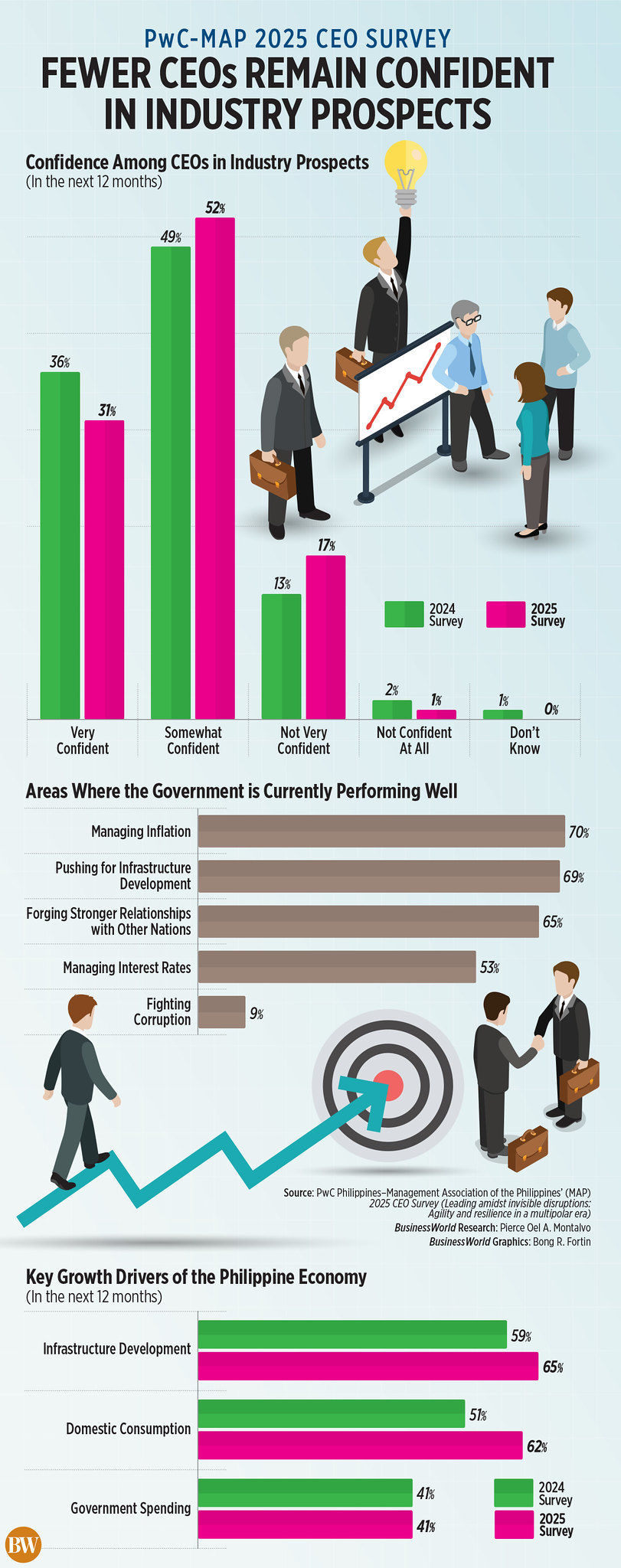
Chief executives in the Philippines remain optimistic about industry prospects and are ramping up investments in people and technology to drive growth, a recently conducted survey showed.


“CEOs in the Philippines see both the risks and opportunities that lie ahead, such as the rising digital economy, sustained consumer spending, robust banking system and lower inflation and interest rates, among others,” PwC Philippines Chairman Roderick Danao said in a statement accompanying the release of the 2025 CEO Survey.


Optimism for the next 12 months was said to be strong, with 83 percent of survey respondents confident about the outlook for their industries and 84 percent expecting revenue growth.


The upbeat sentiment was said to be due to the country’s solid macroeconomic fundamentals, including within-target inflation and a robust monetary policy and banking system, sustained consumer spending, lending growth and higher liquidity.

However, more than half of the CEOs (52 percent) raised fears that their companies would no longer be viable after 10 years if changes were not made. Inflation was tagged as a key risk by 94 percent, followed by macroeconomic volatility (93 percent).


Cyber risks are another major concern and were cited by 84 percent of the respondents.


Adapting to change


ree

CEOs were said to be aware of the headwinds with digital transformation particularly high on the agenda: 68 percent said they had integrated artificial intelligence (AI) into strategies and plans and 60 percent claimed implementation had started.


Respondents also had high expectations for generative AI, with 89 percent saying it would improve products and services, and most noted the need to upskill workers to extend business viability.


Eighty-two percent said they were focused on upskilling, 78 percent said they were pushing forward with automation initiatives, and 63 percent claimed to be using advanced technologies.


Sixty-two percent said talent retention and skill shortages were their top concerns, while 51 percent pointed to resource constraints.


Forty-seven percent, meanwhile, tagged the pull between short-term pressures and long-term goals.


As part of adaptation measures, companies were said to be revamping their decision-making processes, with 45 percent claiming shorter timelines and more frequent reviews.


Consultations are also being expanded, with 64 percent drawing on diverse executive perspectives and 62 percent seeking outside views.


‘More agile’


“This year’s survey shows that leaders are being more agile to ensure better service, shorter lead times and sustained outcomes,” PwC Philippines partner Trissy Rogacion said in the statement.


“By accelerating decision-making processes and streamlining workflows, organizations are not only enhancing the customer experience but also maintaining the momentum needed for long-term growth and resilience.” This year’s survey, which was answered by nearly 200 CEOs, was conducted from July 22 to Aug. 25, 2025, with the majority of respondents being members of the Management Association of the Philippines.


Other findings of the poll were that infrastructure development (65 percent) and domestic consumption (62 percent) would be the primary drivers of economic growth over the next 12 months and that the government was doing well in terms of pushing for infrastructure (69 percent).


The state also scored high in terms of foreign relations (65 percent), managing inflation (70 percent) and managing interest rates (53 percent), but just 9 percent of the respondents said it was doing well against corruption.


A quarter (25 percent) expect global economic growth to slightly decline over the next 12 months while just 20 percent said their business was facing threats from US tariffs.

Thirty-five percent said they would be revisiting plans to enter a new industry in the year ahead, 28 percent said they would expand outside the Philippines, and 17 percent would consider selling a stake in existing businesses.


Source: Manila Times


© Copyright 2018 by Ziggurat Real Estate Corp. All Rights Reserved.

  • Facebook Social Icon
  • Instagram
  • Twitter Social Icon
  • flipboard_mrsw
  • RSS
bottom of page