top of page
  • Writer: Ziggurat Realestatecorp
    Ziggurat Realestatecorp
  • Aug 20
  • 3 min read

In his fourth State of the Nation Address (SONA), President Ferdinand R. Marcos, Jr. underscored healthcare as a central pillar of national development, highlighting landmark reforms and programs designed to bring accessible, affordable, and equitable care to every Filipino.


A key focus of the President’s address was the mental well-being of Filipino youth. With growing concerns over bullying and depression in schools, he ordered the hiring of additional guidance counselors in public schools to ensure that students receive the psychological support they need.


The administration is also investing in early childhood development. President Marcos announced the allocation of P1 billion to establish Barangay Child Development Centers (CDCs) in 328 low-income barangays. These CDCs will serve as vital daycare hubs that monitor immunization, nutrition, and growth of children under six, while providing supplementary feeding.


“The top priorities are far-flung areas. And this is just the start,” the President said, vowing to address the lack of daycare centers.


To strengthen disease prevention and early intervention, the Department of Health (DoH) has been tasked to “fast-track its childhood immunization program” and ensure that all Filipino children are fully immunized as soon as possible. Complementing this directive is the launch of the YAKAP Caravan — short for Yaman ng Kalusugan Program Para Malayo sa Sakit. This enhanced version of PhilHealth’s Konsulta Program expands access to outpatient services, essential medicines, laboratory tests, and even cancer screening at accredited facilities.


Addressing the alarming rise in obesity rates, particularly among adults aged 20 and above, President Marcos encouraged Filipinos to embrace active lifestyles. He called on local government units (LGUs) to revitalize public parks and plazas and to organize activities such as sports competitions, fun runs, Zumba classes, and aerobics sessions.


To further promote wellness, the President called for an expansion of “Car-Free Sundays,” an initiative now practiced in several major cities including Metro Manila, Baguio, Cebu, Iloilo, and Davao. The Philippine Sports Commission (PSC) will also open its track and field ovals in Pasig City, Manila, and Baguio City to the public free of charge.


Improving access to urgent care was another top priority. The President reported that 53 Bagong Urgent Care and Ambulatory Services (BUCAS) centers have been established in 32 provinces. These intermediate healthcare facilities bridge the gap between rural health units and hospitals, offering services such as minor surgeries and diagnostic testing. Over a million Filipinos have already benefited from BUCAS services between March 2024 and March 2025.


Another milestone emphasized in the SONA was the enhanced PhilHealth (Philippine Health Insurance Corp.) benefit packages rolled out under the Marcos administration.


Notably, the Z benefits package for kidney transplants was increased by more than 230%, from P600,000 to P2.1 million. In addition, the number of covered hemodialysis sessions has been raised from 90 to 156 annually, effectively covering the standard thrice-weekly dialysis regimen for a full year.


“For patients requiring dialysis, your thrice-weekly sessions and medicines are now free for the whole year. If a kidney transplant is needed, we have raised the coverage… and starting this year, PhilHealth will also cover health services and medicines after the kidney transplant,” the President said.


Other improvements to the PhilHealth Z benefits include coverage for major cardiac procedures such as heart valve replacements and post-surgical cardiac rehabilitation. PhilHealth has also raised coverage for severe dengue from P16,000 to P47,000 and for mild dengue from P10,000 to P19,500.


PhilHealth benefits for cataract surgery have significantly increased as well, from P16,000 to P80,000, expanding access to vision-restoring procedures for senior citizens and vulnerable groups. Persons with disabilities (PWDs) have also received added support, with PhilHealth now covering mobility devices like wheelchairs, walkers, and crutches, as well as rehabilitation services. The national government continues to shoulder PhilHealth premiums for all PWDs.


For cancer patients, the administration continues to implement the Cancer Assistance Fund (CAF), a DoH program mandated by the National Integrated Cancer Control Act (NICCA). The government has also earmarked an additional P1.7 billion for cancer medicines not yet covered by PhilHealth. President Marcos also affirmed support for human papillomavirus (HPV) vaccination, which helps prevent cervical and other HPV-related cancers.


A commitment reiterated by the President is the continuation of the Zero Balance Billing (ZBB) policy in DoH hospitals. Under this scheme, patients no longer need to worry about settling their hospital bills, as expenses for basic accommodation are covered in full by PhilHealth and government funds. This initiative ensures that patients and their families are not burdened by the financial complexities of healthcare access during critical times.


Through these sweeping reforms, President Marcos reaffirmed his administration’s vision of a healthier, more resilient Philippines. By addressing gaps in mental health, childhood care, disease prevention, and treatment affordability, the government is investing not only in people’s health but in the nation’s future.


The country’s economic transactions with the rest of the world will come under increasing pressure as global trade headwinds intensify, a Fitch Group unit said.


“We now expect the Philippines’ external position to deteriorate as trade fragmentation and its knock-on effects on global demand will weigh heavily on exports,” BMI Country Risk & Industry Research said in a report released last Friday.


“This outlook is hardly surprising, given that key trading partners are facing mounting challenges,” it added.


BMI said the country’s current account — a measure of the flow of goods, services and income — was likely to see its current shortfall widen over the medium term compared to the historical average.


It was at 3.7 percent of gross domestic product (GDP) in the first quarter of 2025, nearly double from 1.9 percent a year earlier, and is expected to average 2.8 percent over the next three years compared to the 2015-2019 average of 0.4 percent.


ree

The goods trade deficit was projected to expand to $90.5 billion by 2028, equivalent to 14.2 percent of GDP, from $68.6 billion in 2024 (14.9 percent of GDP), although a steady rise in services trade and remittance inflows will provide an offset.


The United States, which currently accounts for 16 percent of total Philippine exports, is expected to see economic growth slow to 1.7 percent in 2025 from 2.8 percent in 2024 due to high interest rates and policy uncertainty.


China — another major market — also continues to struggle with a prolonged property downturn that is expected to drag growth down from 5.0 percent in 2024 to a projected 4.8 percent in 2025 and 4.2 percent in 2026.


“Beyond the two economic giants, the global trade landscape is clouded by a rise in US tariffs, which we think will impact the global economy more negatively in the coming years,” BMI said.


The services sector, which has historically helped offset trade deficits, may provide limited relief. The Philippines commands about 15 percent of the global business process outsourcing market, contributing around 7.5 percent to GDP.


However, with weaker global demand for services, BMI warned that the sector would remain vulnerable.


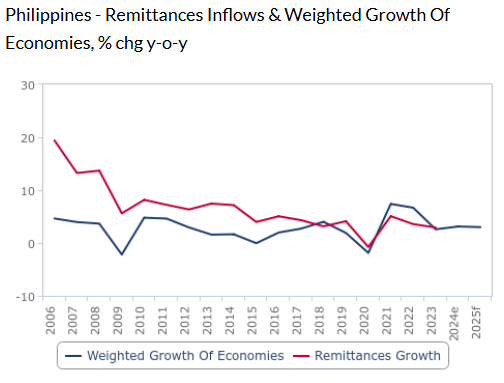
Remittances, another key pillar of the external sector, are also forecast to slow. BMI noted that remittance growth historically tracks economic conditions in major source countries.


ree

With slower economic growth expected in the US (40 percent of inflows), Singapore (7 percent), Saudi Arabia (6.2 percent), Japan (5 percent) and the United Kingdom (4.7 percent), inflows are likely to soften in 2025 compared to 2024.


BMI, however, projects a gradual improvement in the current account balance beyond 2029.


By 2034, the country is forecast to record a surplus equivalent to 0.8 percent of GDP, supported by continued growth in services exports and steady remittance inflows.


  • Writer: Ziggurat Realestatecorp
    Ziggurat Realestatecorp
  • Aug 18
  • 3 min read

The government remains optimistic about bringing down poverty to single-digit levels by 2028 even after lowering its economic growth targets.


Slower growth often poses difficulties for poverty reduction, the Marcos administration acknowledged, but stressed that recent progress supported a decision to retain existing goals.


“While we lowered our growth targets, we remain optimistic about reducing poverty rates to single-digit levels by 2028,” the updated Philippine Development Plan (PDP) released late Saturday states.


“While slower economic growth typically poses a challenge to reducing poverty, the recent achievement provides a strong rationale for retaining current poverty targets,” it adds.


Economic managers in June cut this year’s growth target to 5.5-6.5 percent from 6.0-8.0 percent, taking into account recent economic developments and external headwinds.


For next year until 2028, growth is also expected to range within a narrower 6.0-7.0 percent range instead of 6.0-8.0 percent.


“Coupled with the administration’s sustained focus on key priorities, such as health and food security, we expect the impact of growth to be more inclusive and pro-poor, supporting the attainment of our poverty targets,” the PDP states.


Data from the Philippine Statistics Authority (PSA) shows that the proportion of Filipinos living in poverty dropped to 15.5 percent in 2023 from 18.1 percent in 2021. The government expects this to further decline to between 12-13 percent this year.


By 2027, poverty incidence is projected to fall within 10-11 percent, slightly wider than the earlier forecast of 10-10.3 percent. The target for 2028 was also expanded to 8.0-9.0 percent from the previous range of 8.8-9.0 percent.


‘Intensifying efforts’


“Poverty incidence continues to fall, and we are intensifying efforts to ensure that the benefits of economic growth reach all regions and communities,” Socioeconomic Planning Secretary Arsenio Balisacan said.


He said the government was looking to improve the efficiency of social assistance programs by developing a dynamic social registry and refining targeting protocols.

To further empower beneficiaries of “ayuda” or aid programs, Balisacan said that these would be connected to financial literacy and employment facilitation initiatives to help build resilience and the ability to withstand future shocks.


Moreover, transformative social protection is expected to empower individuals and households to rise out of poverty by addressing underlying vulnerabilities and promoting sustainable livelihoods, rather than simply offering temporary relief.


“By strengthening systems that build resilience, it helps prevent people — especially the most vulnerable and marginalized — from falling into poverty when exposed to shocks and risks,” Balisacan said.


Income goal ‘within reach’


The Department of Economy, Planning and Development chief, meanwhile, also said that the country was poised to become an upper-middle-income economy.

“Achieving upper-middle-income status is no longer a distant aspiration — it is now within reach,” Balisacan said.


“Nonetheless, we still have much to do,” he added.


The country’s gross national income (GNI) per capita has risen steadily, from $4,010 in 2022, $4,320 in 2023 and $4,470 in 2024, falling $26 short of achieve the income status that requires a GNI per capita ranging from $4,496-13,935.


“This upward trend surpassed our PDP targets and brought us within reach of the upper-middle-income country threshold, currently set at $4,496,” Balisacan said.

Under the previous development plan, the government set a target of raising GNI per capita to between $4,814 and $4,920 this year. This goal remains unchanged in the updated plan.


For 2026 to 2028, however, targets were revised downward.


The 2026 GNI per capita projection was lowered to a range of $5,124-5,210 from $5,256-5,563. For 2027, this was cut to $5,452 -5,589 from $5,645-6,056, while the 2028 target was adjusted to $5,882-6,081 from $6,044-6,571.


“The country’s progress toward upper-middle-income status will be accompanied by meaningful advances in social development,” Balisacan said.


The government remains committed to advancing human development and building a more dynamic, inclusive labor market, he added.


By diversifying the drivers of economic growth, the aim is to improve job quality and provide more stable, productive, and dignified employment opportunities for Filipinos.


Source: Manila Times


© Copyright 2018 by Ziggurat Real Estate Corp. All Rights Reserved.

  • Facebook Social Icon
  • Instagram
  • Twitter Social Icon
  • flipboard_mrsw
  • RSS
bottom of page