top of page
  • Writer: Ziggurat Realestatecorp
    Ziggurat Realestatecorp
  • Jul 29
  • 2 min read

But ratio lower than 51.4% in 2021, the last time that WB published its triennial report


The proportion of Filipinos with financial accounts slightly fell in 2024 compared with three years ago, the World Bank (WB) Group reported, highlighting the challenges of onboarding the rest of the population to the formal financial system.


In its Global Findex 2025 report, the Washington-based institution found that 50.2 percent of Filipinos aged 15 years old and above owned an account with banks and other regulated entities such as credit union, microfinance institution or a mobile money service provider.


This was 1.2 percentage point lower compared with the previous share of 51.4 percent back in 2021—the last time that the WB Group published its triennial report.

The latest data on financial account ownership in the Philippines were based on the results of 1,000 interviews, with a margin of error of 3.5 percent.


Underperforming vs peers


As it is, the rate of financial account ownership in the Philippines was lower than the 83.3 percent average for the East Asia & Pacific and 70.4 percent for lower-middle-income economies.


The findings of the WB Group also fell short of the goal of the Bangko Sentral ng Pilipinas to include at least 70 percent of Filipino adults in the formal financial system by 2023.


The BSP has yet to release the results of its latest financial inclusion survey.

Notably, the decline in account ownership happened even as BSP data showed that 57.4 percent of total retail transactions in the country in 2024 were cashless. This surpassed the government’s 2024 goal to convert 52 to 54 percent of retail transactions to digital.


‘Concerning’ decline


John Paolo Rivera, a senior research fellow at state-run think tank Philippine Institute for Development Studies (PIDS), said the dip in financial account ownership was “concerning” as it ran counter to the “digital gains” that the country had seen recently.


“It suggests that economic hardship, job informality and limited digital access in rural areas may have offset earlier progress. The pandemic may have pushed people to open accounts for aid or transactions, but without sustained income or digital literacy, usage and retention likely fell,” Rivera said.


WB Group data showed that among the Filipinos who own accounts, 33.5 percent were maintained with banks “or similar financial institutions.” Meanwhile, 32.7 percent of them were “digitally enabled” accounts, and 28.8 percent were mobile wallets.

This is the first time that the report included data on personal mobile phone ownership and internet use.


Technology as enabler


The report added that 23.9 percent of Filipinos saved money using formal financial accounts in 2024, up from 20.8 percent in 2021.


Globally, the WB Group said mobile phone technology played a key role in the increase in formal saving.


“Financial inclusion needs more than just access. It needs meaningful use,” PIDS’ Rivera said.


“The government and private sector must invest in financial education, rural connectivity and trust-building to bring the remaining half of Filipino adults into the system,” he added.


Source: Inquirer


  • Writer: Ziggurat Realestatecorp
    Ziggurat Realestatecorp
  • Jul 28
  • 2 min read

Pag-IBIG Fund is offering a special subsidized interest rate of three percent per annum for the first five years of housing loans under the Expanded Pambansang Pabahay para sa Pilipino (Expanded 4PH) Program.


The special rate is available to eligible members and overseas Filipino workers for the purchase of socialized housing units – which now include house-and-lot units, condominium units and Pag-IBIG acquired assets.


The initiative supports President Marcos’ directive to expand access to affordable and dignified housing, in line with the administration’s Bagong Pilipinas vision.


“We are pleased to report that Pag-IBIG Fund has once again stepped forward in its commitment to helping more Filipinos secure dignified homes,” said Jose Ramon Aliling, Secretary of the Department of Human Settlements and Urban Development (DHSUD) and chairperson of the Pag-IBIG Fund board of trustees.


“Together with the enhancements under the Expanded 4PH Program – which now covers both vertical and horizontal housing developments – Pag-IBIG Fund’s wider home financing options ensure that more Filipinos can finally achieve homeownership.

This is our solid commitment to President Marcos’ vision of providing decent shelter through a sustainable housing program under the Bagong Pilipinas banner,” Aliling said.


Aliling also cited the support from the private sector, noting that developers have committed to building more than 250,000 socialized housing units nationwide under the Expanded 4PH Program, significantly accelerating the government’s housing efforts.


Under the Pag-IBIG Housing Loan for the Expanded 4PH Program, first-time homebuyers – particularly those earning less than P47,856 per month in the National Capital Region and less than P34,686  outside NCR – may avail of the subsidized three percent interest rate for the first five years of the loan. All overseas Filipino workers, regardless of income, also qualify for the special rate.


The loan may be used to purchase quality socialized house-and-lot units and condominium units under accredited Expanded 4PH projects, priced up to P850,000  and P1.8 million, respectively.


It may also be used to purchase Pag-IBIG acquired assets with net selling prices that fall within these ceilings.


The program further offers additional financing of up to P100,000 for home improvements, such as utility connections and home fixtures, and provides a 100-percent loan-to-value ratio, meaning borrowers are not required to provide cash equity.


Pag-IBIG Fund chief executive officer Marilene Acosta said the agency’s ability to offer low interest rates stems from its strong collection efficiency, eliminating the need for external borrowing.


She added that the initiative aligns with Pag-IBIG Fund’s 10-year plan to deliver double-digit dividends on members’ savings while allocating half of its housing portfolio to loans with a three-percent interest rate through efficient asset management.


Source: Philstar


  • Writer: Ziggurat Realestatecorp
    Ziggurat Realestatecorp
  • Jul 27
  • 6 min read

Companies like Compass, Rocket, and Zillow are trying to create one-stop shopping venues.


The housing market is barreling toward its third bad year of home sales. Once demand roars back, real estate transactions could look different for buyers, sellers, and investors. Anemic home sales are accelerating a housing market reconfiguration long in the making. In the coming years, it may be more common to purchase a home from one of the big public builders than a local developer, or secure a mortgage from the same portal you used when shopping for a home.


Big real estate companies are building digital platforms to keep more parts of the home purchase transaction under one roof—and taking business from real estate brokerages and mortgage lenders. “Anything that makes things easier for people—that’s where the world is moving,” says Tim Bodner, PwC’s real estate deals leader.


The fight for dominance recently spilled into the courts. Compass, the largest U.S. brokerage by sales volume, sued listings portal Zillow Group over new rules regarding listings that are initially viewable only by its agents and their clients. The lawsuit isn’t just a fight over wonky listing rules, but a conflict about the shape of the future housing market.


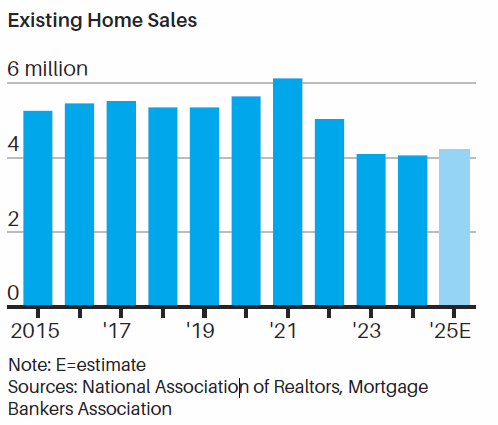
Consumers have been backing away from buying a home for several years. The number of existing homes sold fell to nearly 30-year lows in both 2023 and 2024. In the first five months of 2025, homes sold at an average seasonally adjusted annual rate of about 4.1 million, down from more than six million as recently as 2021, according to National Association of Realtors data.


The whole sector is under pressure until sales climb to at least five million, says Leo Pareja, CEO of brokerage eXp Realty. That’s far away: The Mortgage Bankers Association expects existing home sales to ramp up in the coming years but to remain below five million through 2027, as prices hold firm and mortgage rates remain above 6%. The path ahead for consumers will look increasingly streamlined—and is rife with both opportunities and risks.


Shifting Winds


 It isn’t just buyers and sellers backing out of the market. The National Association of Realtors, the industry’s largest trade group, is budgeting for its membership to decline to 1.2 million in 2026, from nearly 1.6 million as recently as 2022. That’s in part “due to the housing market’s current headwinds,” a NAR spokesperson says.


“There’s going to be sort of a reckoning” if sales remain slow, says Columbia Business School professor of real estate Stijn Van Nieuwerburgh. “Probably a bunch of people are going to quit this profession altogether.” Where some smaller brokerages see trouble, others see buying opportunities. Compass, a $3.2 billion real estate brokerage based in New York, grew its ranks of principal agents nearly 42% in this year’s first quarter from the year prior, largely because of its acquisitions. “Most brokerages are really struggling financially,” says Rory Golod, Compass’ president of growth and communications. “They don’t have the size, the scale, and sort of the balance sheet to get through this.”


ree

Consolidation is coming to homebuilding, too. At a time when more builders are offering buyer incentives or slashing prices, the big players’ economies of scale allow them to keep costs lower. “In a slower and choppier market, mergers and acquisitions get more common,” says Ali Wolf, chief economist of real estate research firm Zonda. Publicly traded home builders comprised 52% of all new home sales in 2024, a larger share than anytime since at least 2005, Zonda data show. That could rise as high as 65% in the future, says Wolf.


Perhaps most emblematic of where housing is headed is the coming unification of Rocket, the nonbank lender best known for mortgage origination, with mortgage servicer Mr. Cooper and brokerage and home-listing portal Redfin. The three companies “realize that we are stronger together than we would be apart,” says Varun Krishna, Rocket’s CEO. The combined company will be the largest mortgage servicer and second largest lender in the U.S., according to Inside Mortgage Finance data. Redfin, meanwhile, gives them “the brand name and real estate brokerage that they never had before,” says Wedbush Securities analyst Jay McCanless.


Across categories, consumers now expect a more personalized experience, says David Steinbach, global chief investment officer of Hines, a real estate investment manager with $90 billion in assets. “That consumer taste for a better service, better outcome— which only data can do—means the scaled groups are going to win. The big are going to need to get bigger in order to better serve the needs.”


The Future


Companies that derive earnings from the homebuying process—such as listing portals, mortgage companies, and brokerages—have long looked for ways to capture a bigger slice of the pie in a fractured housing market. They may have finally settled on a recipe.

Zillow emerged from the 2021 failure of its volatile business buying and selling homes with a new plan: build a “housing super app” offering a range of housing services to buyers, sellers, renters, and agents in one place.


It hasn’t been a smooth ride. Zillow stock is down 5% this year, and 65%  below its pandemic high-water mark. But its push to integrate mortgages— whether through a mortgage marketplace or a lending arm of its own—into the buyer experience, along with investments in rentals and tools for agents, is finally paying off.


Zillow expects to be profitable under generally accepted accounting principles in 2025 for the first time since 2012. “The silver lining of a bad macro is it forces you to really be crisp about what’s working and what’s not working,” says Zillow CEO Jeremy Wacksman.

In the company’s super-app future, the homebuying transaction will never leave the company’s orbit. The whole process—shopping, hiring and communicating with an agent, talking to a loan officer, making an offer, getting a mortgage, and closing—will happen “in the palm of your hand inside an app like Zillow,”Wacksman says.


Across the spectrum, big players in real estate are envisioning what a less fractured housing transaction looks like. Buyers shopping with a Compass agent now have access to a dashboard to keep track of their communication, forms, to-dos, and referrals.

Realtor.com—a home-listings portal run by Move, which, like Barron’s, is owned by News Corp—sees an opportunity “to create an open marketplace, not just for real estate services, but for mortgage services and more,” says Move CEO Damian Eales. “This part of our business will evolve quite significantly in coming years.”


The Consumer


Mega-companies come with both opportunities and risks for consumers. Rocket, Zillow, and others see the opportunity to cut down on friction for buyers and sellers by uniting disparate parts of the housing ecosystem. “The more integrated the experience is, the easier it is to actually lower costs, and then pass on savings to the person who matters most, which is the consumer,” says Rocket’s Krishna.


That isn’t the way some left-leaning politicians see it. In a letter to the Department of Justice and the Federal Trade Commission, five senators including Elizabeth Warren (D., Mass.) and Bernie Sanders (I., Vt.) said that Rocket’s Redfin and Mr. Cooper deals “may reduce choice and raise prices for American families in the housing market” at a time when costs are already high.


“I couldn’t disagree more,” says Rocket’s Krishna.


No matter how a buyer purchases a home, it pays to consider the competition. Freddie Mac in 2023 said that borrowers who compared quotes from at least four mortgage companies stood to save as much as $1,200 a year compared with those who only sought one offer. “Sometimes the way these platforms work is they basically exploit impatient consumers,” says Columbia’s Van Nieuwerburgh. “It’s nice and it’s convenient, and they basically end up overpaying for that convenience.”


But bigger companies could also cut costs, particularly when it comes to home-building, says Van Nieuwerburgh. “There’s a huge number of very small construction firms that are frankly very inefficient,” he says. Deregulation efforts “could potentially lead to some much-needed consolidation,” resulting in more homes getting built—and more options for buyers.


As companies converge on similar visions of the user experience, they diverge on how it will be structured. Take private listings, for example: Advocates like Compass say sellers should be able to test the market before listing to the whole world, while critics like Zillow and eXp say such networks disadvantage buyers. The debate has split the industry down the middle, and is already changing the homebuying process. While Compass encourages sellers to list privately first, Zillow and Redfin have banned listings that aren’t immediately syndicated.


The industry’s evolution won’t stop with consolidation. “You finally have industry participants…all rethinking how things should work and criticizing existing processes that have been an afterthought for the past century,” says KBW analyst Ryan Tomasello.


Source: Barron's


© Copyright 2018 by Ziggurat Real Estate Corp. All Rights Reserved.

  • Facebook Social Icon
  • Instagram
  • Twitter Social Icon
  • flipboard_mrsw
  • RSS
bottom of page