top of page
  • Writer: Ziggurat Realestatecorp
    Ziggurat Realestatecorp
  • Jul 1
  • 2 min read

Business sentiment fell in the second quarter, the Bangko Sentral ng Pilipinas (BSP) reported late on Friday, primarily due to worries over unilateral tariffs ordered by US President Donald Trump.


The overall confidence index (CI) in the BSP’s latest Business Expectations Survey dropped to 28.8 percent from 31.2 percent three months earlier.


The primary concern raised by survey respondents, the BSP said, “was the potential economic effects of a 17-percent reciprocal tariff on Philippine exports to the US.”


“Although the higher tariff rate has been paused for 90 days and reverted to 10 percent, businesses still view this as a sign of rising global trade uncertainty,” it added.


“Businesses also expect fewer clients and orders in Q2 2025 due to the expected slowdown in business activity after the May midterm elections and the sugar off-milling season,” the BSP continued.


Sentiment was also lower with regard to the following quarter and the next 12 months, with the CIs for the two periods falling to 39.3 percent and 51.0 percent, respectively, from 45.4 percent and 56.4 percent.


For the third quarter, respondents cited global trade tensions that may be triggered by the US tariffs and also said that demand could drop due to the rainy season.


The more cautious year-ahead outlook, meanwhile, was attributed to the above factors and “expectations of fewer clients and orders due to expiring contracts and softer market conditions...”


Second-quarter sentiment was more upbeat among construction (38.2 percent from 35.8 percent), but declined for services (31.7 percent from 35.9 percent), wholesale and retail (31.8 percent from 34.1 percent), and industry (17.9 percent from 18.3 percent) sectors.


Anticipated projects during the summer lifted the construction sector outlook, the BSP said.


For the wholesale and retail trade and services sectors, the lower optimism was said to be “primarily due to concerns over US tariffs.”


“Additionally, weaker demand from rental contract expirations and client losses to competitors, further weighed on their sentiment,” the central bank added.


As for the next quarter, construction and services firms were less optimistic. The industry sector was more upbeat, meanwhile, while wholesale and retail trade sentiment was little changed.


Over the next 12 months, long-term confidence dipped in most sectors, with construction the exception.


Companies said that cash positions and credit access would remain tight in the second quarter while the hiring and expansion outlooks for the third quarter and the next 12 months remained positive but were lower compared to three months earlier. 


The peso is expected to strengthen against the dollar over all three periods, averaging P57.09:$1, P57.12 and P57.14, respectively, during the second quarter, third quarter and the next 12 months.


Inflation could rise due to election-related spending, US tariffs, fuel prices, agricultural losses due to bad weather and supply constraints, among other factors, but expectations remained within the government’s 2.0- to 4.0-percent target.


“Within-target inflation supports investments and job creation,” the BSP said.


Source: Manila Times


  • Writer: Ziggurat Realestatecorp
    Ziggurat Realestatecorp
  • Jun 30
  • 2 min read

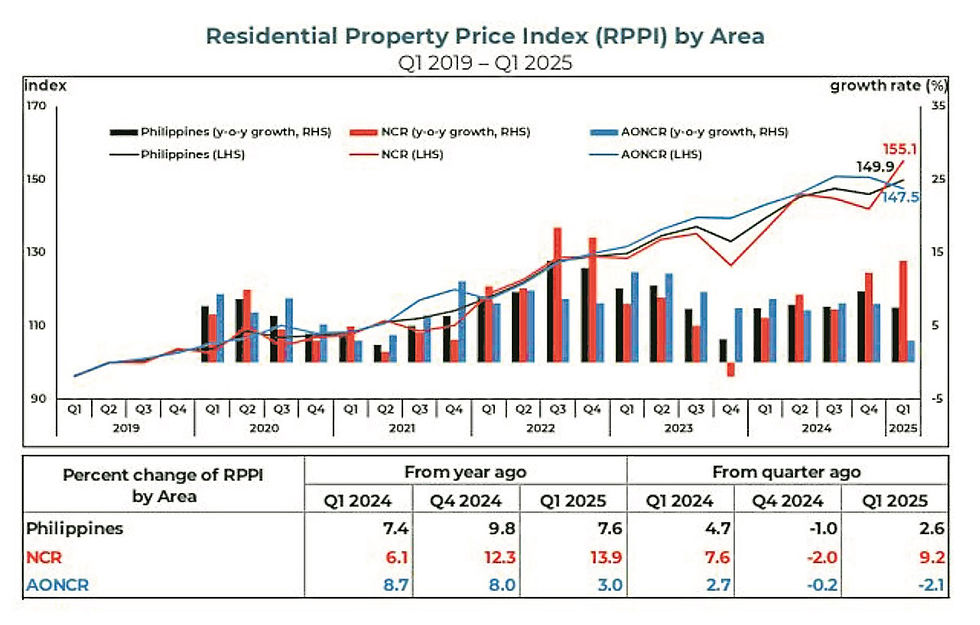
Residential property prices in the Philippines continued to increase, although at a slower pace, during the first quarter of 2025 (Q1 2025), the Bangko Sentral ng Pilipinas (BSP) reported.


Year-on-year growth of the Residential Property Price Index (RPPI) slowed to 7.6 percent in January-March from 9.8 percent in the last three months of 2024. On a quarter-on-quarter basis, prices reversed from the fourth quarter of last year’s 1.0-percent drop, growing by 2.6 percent.


ree

The National Capital Region (NCR) led residential property price growth with a 13.9-percent increase, significantly higher than the 3.0 percent observed in the rest of the country. Quarter on quarter, the NCR saw a 9.2-percent expansion while areas outside it recorded a 2.1-percent drop.


All areas outside the NCR, with the exception of Metro Cebu, recorded higher prices. Houses in Mindanao became 7.6-percent pricer, followed by the rest of the Greater Manila Area (GMA) at 3.8 percent and other areas in the Philippines at 1.1 percent.


Metro Cebu, on the other hand, registered a 1.7-percent drop — its first annual decrease since the first quarter of 2023.


All housing categories contributed to the higher prices, with condominiums and houses recording growth rates of 10.6 percent and 4.5 percent, respectively. Houses measured include single-attached, detached, town houses, duplexes and apartments.


Quarter on quarter, condominium prices grew by 9.9 percent, offsetting a 2.9-percent drop for houses.


The median price for all housing types was P3.37 million, the BSP said, lower than the P4.34 million for condominiums but above the P2.95 million for houses.


Houses in the NCR were the most expensive with a median price of P7.7 million, while condominiums in other areas in the Philippines were the cheapest at P2.5 million.


Residential real estate loans taken out during the first quarter, meanwhile, were mostly used to purchase new housing units (73.2 percent), with the remaining 26.4 percent and 0.5 percent used to buy pre-owned and foreclosed properties.


By type of housing, 63.7 percent of the loans were used for houses and the rest for condominiums.


Just over a fourth, or 27.4 percent, of the property loans were granted in the NCR. Calabarzon (Cavite, Laguna, Batangas, Rizal and Quezon) accounted for 29.9 percent; Central Luzon, 13.8 percent, Central Visayas, 9.6 percent; Western Visayas, 7.9 percent; Davao, 4.5 percent; and Northern Mindanao (2.5 percent).


The NCR and these six regions accounted for 95.6 percent of housing loans granted by banks, the BSP said.


The RPPI calculates the average change in prices of different kinds of housing units over time from bank data on loans made to purchase residential properties.


The quarterly index, beginning the first quarter of 2025, now uses a different methodology to align with international best practices and has been renamed from the Residential Real Estate Price Index. Among others, it now uses acquisition cost instead of appraised value, and the property type has been expanded to include pre-owned and foreclosed units instead of just new ones.


Instead of just the NCR and areas outside it, the latter has further been divided into balance GMA, Metro Cebu, Metro Mindanao and other areas in the Philippines.


Source: Manila Times


  • Writer: Ziggurat Realestatecorp
    Ziggurat Realestatecorp
  • Jun 29
  • 2 min read

Providing support to high-potential small and medium enterprises (SMEs) could boost economic activity and make the Philippines more resilient, the World Bank said.


"The Philippines can further boost its growth prospects by implementing vital reforms that empower SMEs to flourish," the Washington-based multilateral organization said in its Philippine Economic Update report.


As SMEs account for 63 percent of the country's total employment and contribute 36 percent to gross value added, supporting these small businesses can unlock the potential for increased economic dynamism.


The World Bank has trimmed its forecast for Philippine economic growth to 5.3 percent for this year from 6.1 percent previously. Marginal gains of 5.4 percent and 5.5 percent are expected for 2026 and 2027, but all projections fall below the government's 6.0- to 8.0-percent target.


Many SMEs still have low productivity and face difficulties in growing due to limited access to financing, the World Bank said. As a result, they export less and are less involved in global value chains compared to other SMEs in East Asia and the Pacific.


"Regional and global value chains are more than just sales outlets; they are platforms for creating quality jobs and more value-added through benefits from scale, increased competition, and learning," World Bank senior economist Jaime Frias said.


"Firms that engage with international markets are generally more productive, in part because it takes high productivity to export, but also because exporting makes them more productive," Frias added.


The World Bank said SMEs faced several challenges in growing their exports and joining regional and global supply chains. These include limited access to testing and certification services, lack of financing for equipment and quality upgrades and not enough market information to connect with buyers.


It stressed that improving access to testing and certification services would require investments to make this more affordable.


The World Bank also called for simpler rules for laboratories and importing testing equipment and efforts to gain international recognition for Philippine certifications and standards.


Investing in credit information and collateral registries, it added, can help lenders better assess SME risks. This can lower borrowing costs and allow SMEs to invest in better equipment and improve product quality.


"The government can enhance firms' competitiveness by promoting information sharing, which benefits both SMEs and larger companies," the World Bank said.


"This involves closing information gaps by providing easy access to export market data and establishing systems to connect SMEs with larger firms and multinational corporations."


Source: Manila Times


© Copyright 2018 by Ziggurat Real Estate Corp. All Rights Reserved.

  • Facebook Social Icon
  • Instagram
  • Twitter Social Icon
  • flipboard_mrsw
  • RSS
bottom of page