top of page
  • Writer: Ziggurat Realestatecorp
    Ziggurat Realestatecorp
  • Jan 14
  • 3 min read

What Tenants Should Expect at the Start of the Year


The beginning of the year often comes with a familiar message for tenants: “We are increasing the rent.”


But not all rent increases are legal.


In the Philippines, rent adjustments—especially for residential units—are regulated by law. Knowing what landlords can and cannot do empowers tenants to protect their rights and budget accordingly.


This article explains legally allowed rent increases, the applicable law, and what tenants should watch out for.


1. The Governing Law: The Rent Control Act


Rent increases for certain residential units are governed by Republic Act No. 9653, also known as the Rent Control Act of 2009, as extended by subsequent laws.

The Rent Control Act applies to:

  • Residential units (apartments, houses, dormitories, boarding houses)

  • Units leased on a monthly basis

  • Units with rent not exceeding the threshold set by law

⚠️ The law does not apply to commercial spaces or luxury residential units above the rent ceiling.


2. How Much Can Rent Be Increased?


Maximum Allowable Increase

For covered residential units:

  • Maximum increase: 5% per year

  • Applies only to:

    • The same tenant

    • After the expiration of the lease term

💡 This means a landlord cannot impose multiple increases within the same year, nor exceed the 5% cap while the tenant remains in possession.


3. Units Covered by Rent Control


As a general rule, rent control applies to residential units with monthly rent within the statutory ceiling (which varies depending on location and current extensions of the law).

If your unit falls within the rent ceiling, the landlord must comply with the 5% cap.

If your unit is above the ceiling, rent control does not apply—but other legal rules still do, such as contract law and basic principles of fairness.


4. Can the Landlord Increase Rent During the Lease Term?


No.

If you have a fixed-term lease contract, the rent:

  • Cannot be increased mid-contract

  • Must remain the same until the lease expires

Any rent increase:

  • Must be imposed only upon renewal

  • Must comply with the Rent Control Act (if applicable)

A clause allowing automatic increases during the lease term may be void or unenforceable if it violates the law.


5. Can the Landlord Evict You for Refusing an Illegal Increase?


No—refusing an illegal rent increase is not a valid ground for eviction.

Under the Rent Control Act:

  • Tenants cannot be ejected for asserting their rights

  • Retaliatory eviction is prohibited

Illegal eviction or harassment may expose the landlord to:

  • Civil liability

  • Administrative penalties

  • Criminal sanctions in extreme cases


6. Common Landlord Tactics Tenants Should Watch Out For


Tenants should be cautious of:

  • Sudden “reclassification” of the unit to evade rent control

  • Forced contract termination without legal grounds

  • Rent increases disguised as “new charges” or “fees”

  • Pressure to vacate to install a new tenant at a higher rate

📌 The law looks at substance over form—renaming a rent increase does not make it legal.


7. What Should Tenants Do If Faced With an Illegal Increase?


Tenants may:

  1. Request the legal basis for the increase in writing

  2. Check if the unit is covered by rent control

  3. Refuse to pay illegal increases

  4. Seek assistance from:

    • The Barangay

    • Local housing or rent control offices

    • A lawyer or legal aid group


Rising costs do not give landlords a free pass to disregard the law. Understanding rent control rules helps tenants stand their ground—calmly, legally, and confidently.


If you’re unsure whether a rent increase is lawful, ask questions before paying. Silence can be mistaken for consent.


  • Writer: Ziggurat Realestatecorp
    Ziggurat Realestatecorp
  • Jan 12
  • 3 min read

The Asian Development Bank (ADB) said household consumption in the Philippines is likely to rebound in 2026 on the back of easing inflation and interest rates, after a corruption scandal and adverse weather dampened spending in recent months.


However, analysts warned that depending on tax relief to spur consumption could undermine fiscal consolidation efforts.


ADB Country Director for the Philippines Andrew Jeffries said household final consumption expenditure, which accounts for over 70% of the economy, is expected to “strengthen in 2026 amid low inflation and accommodative monetary policy.”

“More broadly, policies need to focus on raising incomes and reducing vulnerability,” he said.


Mr. Jeffries said these measures should include expanding higher‑quality employment, boosting productivity through skills upgrading, and targeted social protection for vulnerable households.


This comes as private consumption growth moderated in the third quarter of 2025, particularly discretionary spending on recreation, hotels and restaurants, partly due to weather‑related disruptions, he said.


Data from the Philippine Statistics Authority (PSA) showed household final consumption expenditure slowed to 4.1% in the third quarter from 5.2% a year ago.


This was the slowest since the 4.8% contraction in the first quarter of 2021. Excluding pandemic years, it was the slowest growth in private spending since the 2.6% increase in the third quarter of 2010.


The PSA will release the fourth-quarter and annual 2025 preliminary gross domestic product (GDP) data, including household consumption, on Jan. 29.


Despite the slower growth in the third quarter, the ADB said spending on essentials, particularly food, remained resilient, supported by low inflation.


Inflation picked up to 1.8% in December from 1.5% in November. This brought the average to 1.7% in 2025.


For 2026, the central bank sees inflation accelerating to 3.2%, but still within the 2-4% target band.


The Bangko Sentral ng Pilipinas (BSP) has so far delivered a total of 200 bps in cuts since August 2024, after it lowered its policy rate by 25 bps to an over three-year low of 4.5% at its Dec. 11 meeting, amid subdued inflation and sluggish growth.


The Monetary Board is scheduled to hold six regular policy meetings in 2026, with the first one set on Feb. 19.


TAX RELIEF?


To spur household demand and ease public concerns over flood control issues, a lawmaker had proposed giving tax relief to Filipinos, but analysts were divided, saying the measure could lift spending but risk undermining fiscal consolidation.


Senator Erwin T. Tulfo filed a bill in the Senate in October to provide a one-time, one-month income tax holiday for individual taxpayers receiving compensation income, effective on the first payroll month immediately following the bill’s approval.

Senate Bill No. 1446, or the One-Month Tax Holiday bill, remains pending at the committee level.


“A tax relief will only delay fiscal consolidation,” Foundation for Economic Freedom President Calixto V. Chikiamco said.


The Marcos administration aims to bring the deficit down to P1.56 trillion, or 5.5% of GDP, in 2025, and eventually to P1.55 trillion, or 4.3% of GDP, in 2028.


Mr. Chikiamco noted that many factors influence consumer spending, such as unemployment, inflation, and wage growth.


“Depreciation of the peso will increase OFW (overseas Filipino worker) incomes and spur consumer spending without decreasing government revenues,” he added.

The peso has breached the P59-a-dollar mark several times since November and sank to a record low of P59.22 on Dec. 9.


Meanwhile, Jonathan L. Ravelas, a senior adviser at Reyes Tacandong & Co., argued that tax relief can boost private consumption, but the program has to be “smart and targeted.”


“Tax relief can help revive spending, especially after a year of high prices and tight budgets,” he said.


“Focus on essentials like VAT (value-added tax) breaks on food and utilities, and give relief to lower- and middle-income families who are more likely to spend,” Mr. Ravelas added.


However, he said tax relief must be “time-bound,” and paired with job creation and price stability, so people feel confident to open their wallets.


“The problem on spending is due to the uncertain environment due to ‘floodgate,’ the government should fix its trust issues so confidence will come back,” Mr. Ravelas said, referring to the flood control mess.


Meanwhile, the ADB’s Mr. Jeffries said improving VAT efficiency and sustaining gains in tax administration through digitalization are key to raising government revenue.


“The proposed tax on single-use plastic bags is a notable measure, serving both revenue and environmental objectives by helping address plastic and solid-waste challenges,” he said.


BIR Commissioner Charlito Martin R. Mendoza earlier said the proposed tax measure is projected to generate between P6 billion and P10 billion annually, “depending on the rate and coverage.”


“Beyond taxation, sustained improvements in expenditure efficiency and public financial management are crucial, particularly to strengthen investment planning, project execution, and governance,” Mr. Jeffries said.


  • Writer: Ziggurat Realestatecorp
    Ziggurat Realestatecorp
  • Dec 23, 2025
  • 2 min read

‘Tis the season to be jolly— and for many Filipinos, it is the prime period to spend, too.

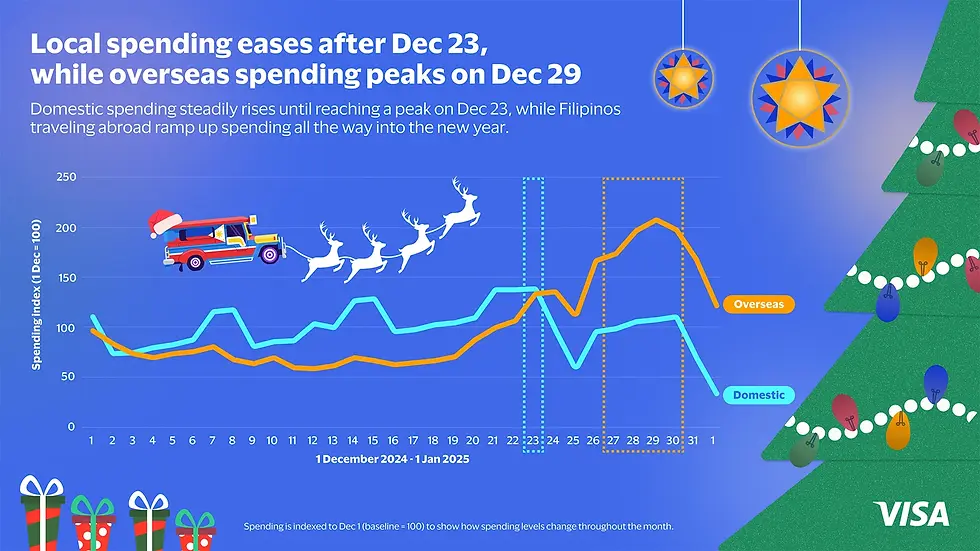
New data from international payments provider Visa show that card transactions by Filipinos rise steadily every December, showing how the Christmas season continues to drive consumer activity in the Philippines.


However, this spending surge plays out differently depending on where Filipinos choose to spend their holidays.


For those staying in the country, spending peaks around Dec. 23, a period Visa describes as the height of the “holiday rush in malls and commercial districts” as shoppers scramble to make last-minute gift purchases ahead of family gatherings.

By contrast, Filipinos traveling overseas tend to open their wallets after Christmas. Their spending peaks on Dec. 29, reflecting “continued leisure and travel-related purchases during overseas vacations,” before tapering off toward the New Year.


Overall, Filipinos abroad register a higher spending peak than those who remain at home. Interestingly, spending drops sharply on Christmas Day itself for both groups, before climbing again in the days between Christmas and New Year.


Visa says the data points to the enduring value of Christmas, whether celebrated at home or abroad.


“Christmas brings people together and our data [underscore] the holidays’ enduring sociocultural and economic significance to the country,” says Jeffrey Navarro, country manager at Visa Philippines.

Online holiday shopping


As e-commerce continues to expand, a growing share of holiday spending is also moving online, according to data from Lazada.


Electronics sales during its 12.12 sale surged by as much as 1,100 percent compared with regular days, making the category the top seller. The spike reflects how “middle-class households are increasingly turning to e-commerce to improve their home environments,” Lazada says.

Branded goods emerged as winners during the sale, as products at LazMall recorded some of the strongest sales during the campaign. Samsung, Dyson, JBL Nike, POCO, Colgate, UFC, BLK Cosmetics and DDPA were among the top-performing brands.


This trend, Lazada says, suggests that Filipino shoppers are becoming more deliberate, increasingly gravitating toward globally trusted brands even in the digital marketplace that’s crowded with low-cost, third-party alternatives.


Foreigners join spending rush


Foreign visitors in the Philippines also contribute to the holiday spending boom, according to Visa data.


Inbound card payments made by foreign tourists also surge during the Yuletide season, with visitors from the United States leading the bunch, followed by those from Taiwan, Japan, South Korea and Singapore.


Much of this spending is concentrated in the buzzing city of Makati, followed by Parañaque, Cebu, Angeles and Davao.


Spending preferences also vary by nationality. Visitors from the United States, South Korea. Singapore, Australia and Hong Kong allocate most of their spending on lodging, while Taiwanese and Japanese tourists spend more on entertainment.


Indian travelers, meanwhile, spend the largest amount on education and government-related payments. Visitors from Canada and the United States prioritize spending on groceries and food during the holidays.


Source: Inquirer


© Copyright 2018 by Ziggurat Real Estate Corp. All Rights Reserved.

  • Facebook Social Icon
  • Instagram
  • Twitter Social Icon
  • flipboard_mrsw
  • RSS
bottom of page