top of page
  • Writer: Ziggurat Realestatecorp
    Ziggurat Realestatecorp
  • 2 days ago
  • 1 min read

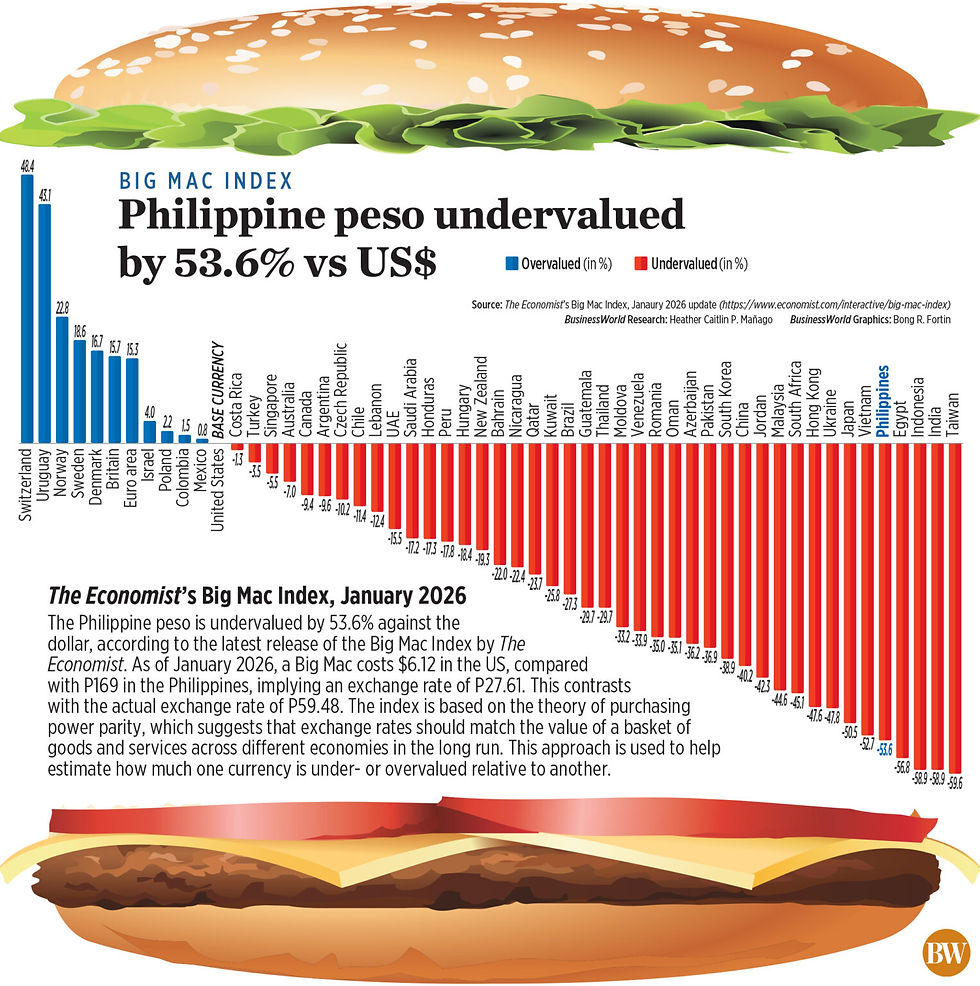
The Philippine peso is undervalued by 53.6% against the dollar, according to the latest release of the Big Mac Index by The Economist. As of January 2026, a Big Mac costs $6.12 in the US, compared with P169 in the Philippines, implying an exchange rate of P27.61.


This contrasts with the actual exchange rate of P59.48. The index is based on the theory of purchasing power parity, which suggests that exchange rates should match the value of a basket of goods and services across different economies in the long run.


This approach is used to help estimate how much one currency is under- or overvalued relative to another.


  • Writer: Ziggurat Realestatecorp
    Ziggurat Realestatecorp
  • Dec 16, 2025
  • 2 min read

The Philippines continues to trail several of its Southeast Asian peers in digital government readiness, reflecting uneven progress in the country’s push to modernize public services through technology.


In the Organisation for Economic Co-operation and Development’s (OECD) latest Digital Government Index (DGI), the Philippines scored 0.28 out of 1. The country ranked third-lowest among the eight Southeast Asian countries that the study covered.


The OECD’s DGI draws on data from Brunei, Cambodia, Laos, Malaysia, the Philippines, Singapore, Thailand and Vietnam, collected between September 2024 and February 2025.


The index was presented in Government at a Glance: Southeast Asia 2025 in cooperation with the Asian Development Bank.


This placed the Philippines below the regional average of 0.37. The Southeast Asian average itself lags the OECD member-country average of 0.61.


“Governments can improve their agility and policy impact by putting digital transformation at the heart of modernization efforts,” OECD said.


The index benchmarks how governments integrate digital technologies and data into policymaking and public service delivery across six dimensions. These are digital by design, data-driven public sector, government as a platform, open by default, user-driven services and proactiveness.


The Philippines recorded a low score of 0.36 in “digital by design,” also placing it third lowest among its regional peers.


This suggests that while digital initiatives exist, they are not yet consistently built into the core design of government operations.


“Setting a strategic vision and clear mandate for digital government is a prerequisite to steer digital government initiatives, and for facilitating more effective and inclusive cross-sector collaboration,” the OECD said.


The group added that all of its surveyed Southeast Asian countries have a mandated government institution or formal coordination body on digital government.


For its part, the Philippines, through the Department of Information and Communications Technology of the Philippines, has developed a National ICT Government Agenda and a Digital Government Masterplan for 2023 until 2028.


4th highest


The Philippines also ranked fourth-highest in proactiveness, with a score of 0.26. The OECD said this could be further improved through the adoption of artificial intelligence (AI), an area where Southeast Asia as a whole continues to lag.


“The adoption of AI can help governments become more proactive. Used strategically and responsibly, governments can leverage AI to enhance public sector productivity, responsiveness and accountability,” the OECD said.


Only three countries in the region currently have a national strategy or agenda that references the use of AI in the public sector, including the Philippines, according to the report.


However, the OECD said the Philippines has yet to deploy AI systems in government operations and does not have binding or non-binding instruments in place to guide the responsible use of algorithms in the public sector.


At the regional level, the Association of Southeast Asian Nations published a guide on AI governance and ethics last year to support member states in developing common principles and safeguards.


More recently, President Marcos Jr. said the Philippines should fully utilize AI to help drive national development, including through legislation, signaling potential policy momentum in the coming years.


Mr. Marcos also approved in May the National Artificial Intelligence Strategy for the Philippines. The Department of Science and Technology initiated this effort.


Report:

OECD (2025), Government at a Glance 2025, OECD Publishing, Paris, https://doi.org/10.1787/0efd0bcd-en.


Source: Inquirer


  • Writer: Ziggurat Realestatecorp
    Ziggurat Realestatecorp
  • Dec 8, 2025
  • 4 min read

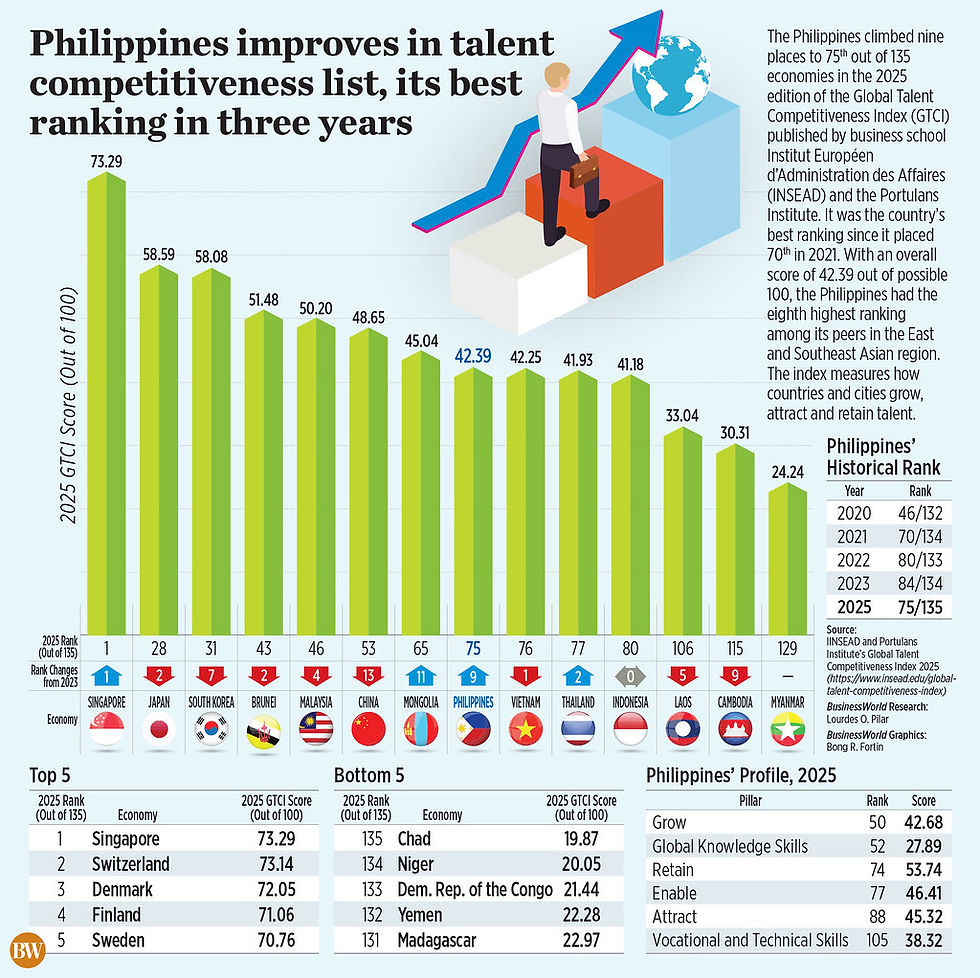
The Philipipnes jumped nine spots in an annual ranking of countries’ ability to attract and retain talent, according to a report by business school Institut Européen d’Administration des Affaires (INSEAD) and the  Portulans Institute.


In the Global Talent Competitiveness Index (GTCI) 2025, the Philippines ranked 75th out of 135 economies, improving from 84th in 2023. It had an overall score of 42.39 out of a possible 100.


This was the country’s best ranking since 2021 when it was at 70th place.


The index looks at how countries and cities grow, attract and retain talent.

“These developments highlight the Philippines’ ongoing efforts to strengthen managerial capability, enhance workforce adaptability, and foster an innovation-driven, digitally connected talent landscape,” the report read.


The Philippines ranked eighth among its peers in the East and Southeast Asian region.

Singapore ranked first overall with a score of 73.29, followed by Japan (28th), South Korea (31st), Brunei (43rd), Malaysia (46th), China (53rd) and Mongolia (65th).


The Philippines was also the top performer among lower middle-income economies, outpacing regional peers such as Vietnam (76th), Thailand (77th) and Indonesia (80th).

“Among lower middle-income economies, Lebanon, the Philippines, and India stand out for their growing emphasis on transferable and future-oriented skills,” the report said.


SOFT SKILLS


Also, the Philippines was surprisingly the only lower middle-income economy in the soft skills top 10, which was dominated by high-income economies led by Denmark, Iceland and Switzerland.


The report said this underscores that “human-centric capabilities — such as communication, teamwork, and adaptability — are increasingly vital drivers of talent competitiveness across all income groups.”


The Philippines ranked 50th in the “Grow” pillar, supported by strong outcomes in lifelong learning (27th), employee development (27th) and high digital engagement, including the 20th ranked use of virtual social networks among professionals.


Market competitiveness also improved, with the Philippines placing 35th in the extent of market dominance and 54th in sustainability.


The Philippine labor market continues to show strong private sector management practices — 12th in professional management, 19th in cluster development and 22nd in ease of finding skilled employees.


“Economies that align education, labor and innovation systems towards adaptive talent development can achieve high performance even with modest income levels,” said Paul Evans, emeritus professor of organizational behavior at INSEAD and co-editor of the report.


Rafael Escalona Reynoso, chief executive officer of Portulans Institute, said the most crucial skills today are adaptive ones: “the ability to collaborate, think across disciplines, innovate under pressure and navigate fast-moving, tech-driven environments.”

“These are the skills that increasingly define a country’s competitiveness — and the GTCI now captures this reality more clearly than ever,” he added.


However, the report noted persistent weaknesses in the Philippines’ ability to attract foreign talent. The Philippines ranked 88th in the “Attract” pillar, dragged down by low external openness metrics such as migrant stock (135th).


Governance and regulatory indicators also pulled down scores in the “Enable” pillar, where the Philippines placed 77th, reflecting gaps in the rule of law, corruption control and political stability.


Despite these challenges, the GTCI findings suggested the Philippines is developing the right capabilities to support higher-value industries.


The country scored above its income-group average in overall GTCI performance — 42.39 versus 33.64 — and demonstrated strong upward mobility relative to peers.


The results come as the Marcos administration pushes reforms in education, skills training and digitalization to strengthen the workforce and attract investment.


The report’s emphasis on adaptability and lifelong learning aligned with efforts to reskill Filipino workers for artificial intelligence- and technology-intensive sectors.

Singapore, Switzerland, Denmark, Finland and Sweden led the index as top performers.


The five lowest-ranking countries were all in Africa — Burkina Faso, Madagascar, Mozambique, the Democratic Republic of the Congo and Chad.


On the Philippines’ low score in attracting foreign talent, University of the Philippines Diliman School of Labor and Industrial Relations Assistant Professor Benjamin B. Velasco said labor migration continues to drain the Philippines of skilled workers, even as the country’s strong English proficiency helps drive its rise in global talent competitiveness.


“It is a good thing that the Philippines is rising in talent competitiveness. Despite evident deficits in basic education, our English proficiency drives talent competitiveness given the reality of global supply chains in services,” he said via Facebook Messenger.

To sustain and expand this progress, he said the government must fix basic education gaps, significantly increase higher-education spending to 6% of gross domestic product and rationalize vocational-technical training.


He also urged the full implementation of the Labor Education Act to embed workers’ rights and career guidance into higher education and technical-vocational curricula.

Federation of Free Workers President Jose Sonny G. Matula said the Philippines’ rise in the index is a bright spot amid concerns over corruption and substandard infrastructure projects.


The improvement showed the country’s strength in developing lifelong learning, digital skills and professional management, he added.


“This is also a reminder to government and business: rankings are not enough — people must feel it in their wages, job security, and quality of education,” he said via Viber, noting the importance of building awareness of decent work through education.


While Filipino talent is globally competitive, Mr. Matula said the larger challenge is ensuring workers aren’t compelled to migrate or endure precarious employment to make ends meet.


© Copyright 2018 by Ziggurat Real Estate Corp. All Rights Reserved.

  • Facebook Social Icon
  • Instagram
  • Twitter Social Icon
  • flipboard_mrsw
  • RSS
bottom of page