top of page
  • Writer: Ziggurat Realestatecorp
    Ziggurat Realestatecorp
  • Aug 29
  • 3 min read

The pulse of cities beats strongest in their transport hubs, where the constant tide of movement defines the rhythm of urban life.


Once regarded solely as conduits for transit, these centers of activity are now shaping entire communities. They have evolved into the foundations of estate developments, driving progress and elevating how people live in connected environments.


The global city model


Around the world, transport-integrated estates reveal the profound influence of mobility on urban form.


In Hong Kong, the MTR has woven residential towers, offices, and shopping complexes directly into its stations, placing daily essentials within minutes of travel. Tokyo’s districts of Shinjuku and Shibuya thrive as dynamic hubs where rail networks converge with retail landmarks, entertainment, and cultural attractions.


London’s King’s Cross has been reimagined into a flourishing district combining education, business, and leisure, all rooted in its transport spine.

Once a declining rail yard, London’s King’s Cross has been reimagined into a flourishing district combining education, business, and leisure, all rooted in its transport spine. These developments show how the strategic joining of transit and real estate generates lasting urban vitality.


Philippine pioneering efforts


The Makati central business district had set the original benchmark for integration long before new estates—weaving together workplaces, commercial centers, and transport access in a cohesive urban fabric.


This global pattern finds resonance in the Philippines, where Ayala Land has spearheaded transport-oriented estates. Arca South in Taguig embodies forward-looking urban design, planned around the future Metro Manila Subway and the South Intermodal Transport System. Vertis North in Quezon City reflects the same vision, standing beside MRT-3 and directly linked to the North Triangle Common Station that will connect several railway lines.


Concentrating offices, residential towers, and retail establishments around transit allows cities to optimize land efficiency in dense districts. (DOTR)

From Makati’s early precedent to today’s emerging estates, Ayala Land illustrates how projects can anticipate infrastructure, establishing growth districts that evolve with the city’s expanding networks.


Urban growth advantages


The impact of these estates extends to the development of metropolitan areas. It influences how these urban regions grow and evolve.


Concentrating offices, residential towers, and retail establishments around transit allows cities to optimize land efficiency in dense districts.


These nodes attract global companies, educational institutions, and retail anchors eager to operate where accessibility drives performance. Reliance on private cars decreases as people embrace convenient public systems.


With national undertakings such as the Metro Manila Subway and the North-South Commuter Railway underway, Ayala Land’s estates complement these efforts, multiplying their economic and social impact.


Shinjuku in Tokyo thrives as dynamic hub where rail networks converge with retail landmarks, entertainment, and cultural attractions.

Through this interplay, transport and real estate reinforce each other, positioning these estates as catalysts for sustained urban vitality, shaping investment confidence, encouraging balanced land use, and setting a precedent for smarter metropolitan planning.


Lifestyle advantages for communities


The advantages extend beyond mobility for residents. Walkable, mixed-use neighborhoods allow work, leisure, and home life to unfold quickly.


Reducing commute times leads to several significant benefits. It gives individuals more time to engage in healthy routines, such as exercise or preparing nutritious meals. Shorter commutes also foster more quality time to spend with loved ones, helping reduce stress and fatigue.


Transport-integrated developments offer more than simple solutions to mobility challenges.

Streets and public spaces become animated with activity, while curated retail and cultural destinations nurture a sense of belonging and identity. In these settings, convenience and vitality combine to shape places where communities thrive.


This integration transforms estates from functional clusters into inspiring districts that people identify with and proudly call home.


Shaping future-ready cities


As Philippine cities continue to densify, the role of transport-anchored estates grows in importance.


Ayala Land’s pioneering efforts demonstrate how private developers can align with national mobility projects to create a lasting impact. These estates embody resilience, adaptability, and inclusivity, essential for future-ready urban centers.


Transport-integrated developments offer more than simple solutions to mobility challenges. They establish the framework for a thriving city life where economic opportunity and human experience converge in one connected vision.


Source: Inquirer


  • Writer: Ziggurat Realestatecorp
    Ziggurat Realestatecorp
  • Aug 28
  • 3 min read

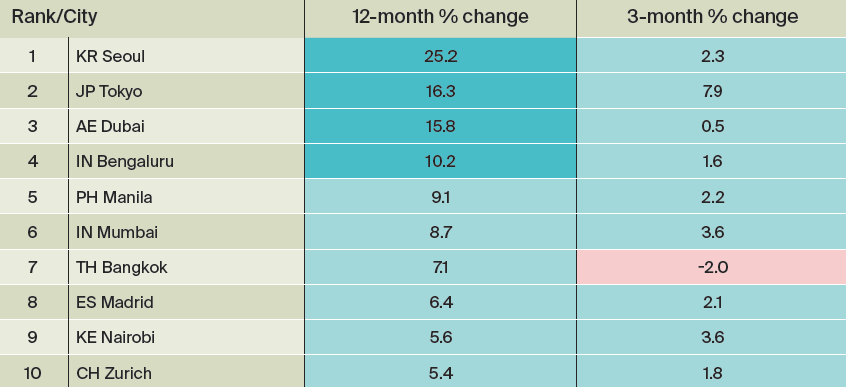
Prime residential prices in Manila rose by 9.1% year on year in the second quarter, ranking the Philippine capital fifth among global cities for price growth, according to the latest edition of Knight Frank’s Prime Global Cities Index (PGCI).


This represents a slowdown from the 26% year-on-year surge recorded in the same period last year, when Manila topped the global rankings.


The PGCI is a valuation-based index that monitors prime residential price movements in 46 cities worldwide, using data from Knight Frank’s global research network. It measures nominal prices in local currency.


Year on year, Manila’s prime residential price growth trailed only Seoul (25.2%), Tokyo (16.3%), Dubai (15.8%), and Bengaluru (10.2%), but outperformed Mumbai (8.7%), Bangkok (7.1%), Madrid (6.4%), Nairobi (5.6%), and Zurich (5.4%).


ree

Manila’s prime residential prices grew faster in April-June than the 1.6% decline recorded in the first quarter.


Over the past five years, Manila ranked among the top markets in terms of real estate price growth at 77.5%, behind only Tokyo (120%), Dubai (107%), Seoul (80.9%), and Miami (80.3%).


Manila’s five-year price growth also outpaced that of Los Angeles (56%), Christchurch (43.9%), Gold Coast (34.2%), Shanghai (32.8%), and San Francisco (32.6%).


“Emerging hotspots like Manila and Christchurch highlight increasing investor appetite in secondary cities,” Knight Frank said.


“Asian cities continue to lead the rankings, but with less vigor than in previous quarters,” it added.


Manila’s prime residential prices also outpaced the 2.3% global price growth in the second quarter.


“We’re seeing a more fragmented market, with some European cities showing surprising strength while former high-flyers in Asia begin to level off,” Liam Bailey, global head of research at Knight Frank, was quoted as saying in the report.


Another analyst commenting on the report, Joey Roi H. Bondoc, director and head of research at Colliers Philippines, said strong demand for units amid limited supply may be helping support Manila’s prime residential market.


“The upper luxury, ultra-luxury segments continue to outperform other market segments, especially the mid-income segment, because the latter is very sensitive to mortgage rates,” he said.


“On the other hand, luxury buyers are awash with cash. If they don’t have the cash right now, probably they sell one or two of their units and then buy another luxury unit.”

The luxury residential segment — typically valued at P20 million and above — has only 3% remaining inventory of ready-for-occupancy units, far below the 32% inventory recorded in the lower middle-income segment, Colliers said in its Second Quarter Property Market Report.


“By prime residential prices, they may be referring to newly launched luxury condominiums in the Core Central Business Districts of Makati, BGC (Bonifacio Global City) and Ortigas. These constitute a very small percentage of the total condominium supply in the market, but are the highest priced units,” Roy Amado L. Golez, Jr., director of research and consultancy at Leechiu Property Consultants, said.


In the coming months, Mr. Bondoc expects more property developers to pivot toward the luxury residential segment.


“More developers will become more prudent when it comes to their launches, but they will cater to the luxury market… so, the share of luxury in the total new launches in Metro Manila will continue to increase,” he added.


“I would tend to think that inflation, interest rates and other factors such as financing and the sourcing of high-end luxury materials will continue to nudge pricing upwards,” Mr. Golez also said.


  • Writer: Ziggurat Realestatecorp
    Ziggurat Realestatecorp
  • Aug 27
  • 2 min read

The Philippines registered a significant improvement in its adjusted misery index in June 2025, reflecting a more favorable balance between inflation, unemployment, and underemployment. The index fell to 16.1 percent, compared to 18.5 percent in June 2024, signaling relief for Filipino households amid easing price pressures and stronger labor market conditions.


What is the Adjusted Misery Index?

The traditional misery index is calculated by adding inflation and unemployment. The adjusted version, however, includes underemployment—a more comprehensive gauge of economic distress. This provides a clearer picture of how many Filipinos are struggling not only to find jobs but also to secure stable, decent-paying work.

Formula:

Adjusted Misery Index = Inflation Rate + Unemployment Rate + Underemployment Rate

Key Economic Indicators (June 2025)


  • Unemployment: Fell to 3.7 percent, equivalent to 1.9 million unemployed, an improvement from 4.5 percent a year earlier.

  • Underemployment: Declined to 11.0 percent from 12.7 percent in June 2024, showing progress in creating better-quality jobs.

  • Inflation: Registered 1.4 percent, a sharp drop from 3.3 percent in the same month last year, with food inflation almost flat at just 0.1 percent.


Putting these figures together:

June 2025 = 3.7 + 11.0 + 1.4 = 16.1%
June 2024 = 4.5 + 12.7 + 3.3 = 18.5%
ree

What Drove the Decline?


  1. Rice Price Stabilization

    • Government interventions, including tariff cuts and expanded supply programs, led to a historic decline in rice prices—down by 14.3 percent, the steepest fall in three decades.

  2. Improved Labor Market

    • Expanded government hiring in education and healthcare, combined with job matching, internships, and training programs, reduced both unemployment and underemployment.

  3. Lower Inflationary Pressures

    • Cheaper food commodities such as vegetables, corn, and sugar helped pull down consumer prices, benefitting especially low-income households.


Why This Matters


  • For Households: The decline translates to greater purchasing power and better job security, particularly for vulnerable groups.

  • For Policymakers: The results highlight the effectiveness of targeted programs in controlling food prices and promoting job creation.

  • For Investors: Lower inflation and stronger employment signal a healthier macroeconomic environment, boosting investor confidence.


Outlook


While the drop to 16.1 percent is a promising sign, risks remain. Potential volatility in global oil markets, El Niño–driven food supply challenges, and animal disease outbreaks affecting pork prices could put upward pressure on inflation in the months ahead. Sustaining momentum will require continued government vigilance, particularly in keeping food affordable and strengthening inclusive job opportunities.


The Philippines’ adjusted misery index in June 2025 shows a clear improvement from last year’s 18.5 percent, reflecting easing inflation and stronger labor conditions. If these trends continue, Filipino households may enjoy a period of greater economic stability heading into 2026.


© Copyright 2018 by Ziggurat Real Estate Corp. All Rights Reserved.

  • Facebook Social Icon
  • Instagram
  • Twitter Social Icon
  • flipboard_mrsw
  • RSS
bottom of page